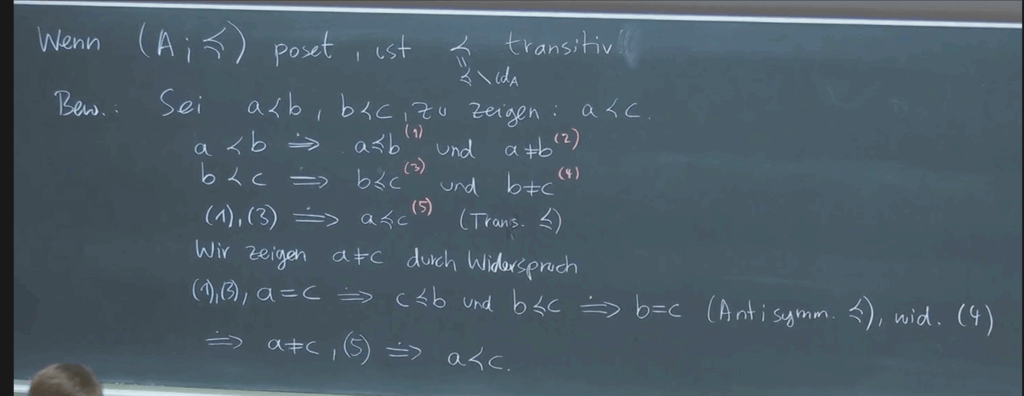
Ein Paar (A,$\preceq$) nennt man dann ein poset (partially ordered set).
Beispiel
$A = \mathbb{Z}, \ \preceq = \le$
- Reflexiv: $a \le a$
- Antisymmetrisch: $a \le b \ \text{und} \ b \le a \Rightarrow a = b$
- Transitiv: $a \le b \ \text{und} \ b \le c \Rightarrow a \le c$
Also ist $(\mathbb{Z}, \le)$ ein Poset.
$\preceq = <$ wäre nicht reflexiv, also würde das nicht gelten.
Beispiel Lexografische Ordnung
Wie im Wörterbuch (wie bei „abc“ < „abd“).
Formal:
$$
(a_1, b_1) \le_{\mathrm{lex}} (a_2, b_2)
\;\;\Longleftrightarrow\;\;
(a_1 \prec a_2)
\;\text{ oder }\;
(a_1 = a_2 \;\text{ und }\; b_1 \sqsubseteq b_2)$$
- Erst nach dem ersten Element vergleichen.
- Nur wenn das gleich ist, entscheidet das zweite.
Eigenschaften
- Reflexiv
- Antisymmetrisch
- Transitiv
Also → Lexikographische Ordnung ist ein Poset
Deckung
Definition 3.26 In a poset (A; ≼) an element b is said to cover an element a if a ≺ b and there exists no c with a ≺ c and c ≺ b (i.e., between a and b).
Example 3.41 In a hierarchy (say of a company), if a ≺ b means that b is superior to a, then b covers a means that b is the direct superior of a.
Geordnet
- In einem Poset (A; ≼) sind 2 Elemente a and b vergleichbar, wenn a ≼ b oder b ≼ a
- Totalgeordnet, wenn alle Elemente in (A; ≼) vergleichbar sind
Example 3.39. (Z; ≤) and (Z; ≥) are totally ordered posets (or simply totally ordered sets), and so is any subset of Z with respect to ≤ or ≥. For instance, ({2, 5, 7, 10}; ≤) is a totally ordered set.
Example 3.40. The poset (P(A); ⊆) is not totally ordered if |A| ≥ 2, nor is the poset (N; |).
Definition 3.30 A poset (A; ≼) is well-ordered if it is totally ordered and if every non-empty subset of A has a least element.
Hasse-Diagramme
Siehe Hasse Diagramme
Sonstiges