Using AI to learn and create
← All postsThe beautiful thing about using agentic AI to co-work is that the limits simply seem endless. It feels like you can achieve anything you want within a day of diving deep, which is an incredible feeling. We are talking about things that would otherwise take months to understand and create.
Lately, I’ve started to fix the things that have annoyed me on my Mac for longer. The following are two examples, there are many more. From Obsidian Plugins over to Terminal CLI’s.
Chrome Extensions
There are webpages that simply do things that you don’t want them to do, or look a way you don’t want them to. Claude Code is incredible at creating Chrome extensions and those are incredibly powerful if utilized in the right way.
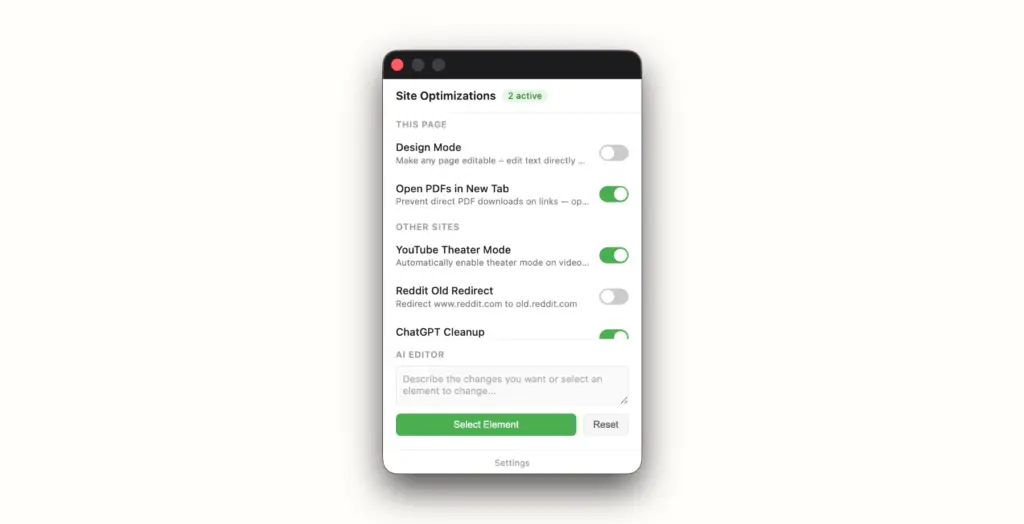
An easy example is how a webpage can decide whether to provide pdf files with the download attribute or not, and therefore whether the file should simply open in the browser or be downloaded directly. There are other ways too (headers, JS) F.ex. moodle assignments always download automatically. But I don’t want them to download always.
So within 10 minutes I created a little extension that on every page makes sure PDF files open in a new tab. It felt so simple.
But it’s important to keep learning, so it is important to use that moment to learn about what you just co-worked. I knew about web development and how downloads are set, but I didn’t know anything about Chrome Extensions. And now I do.
To avoid having to switch to the terminal to create new optimizations, this then quickly became its own extension that can hold an infinite amount of site optimizations.
And all of this was in late September, long before Tweeks.io came along (basically exactly that, but YC funded).
Reverse engineering Dia’s binaries
I didn’t know anything about how macOS applications are packaged and how binary files are working. I use Dia by the Browser Company as my main browser, but not because of its AI features (I barely ever use those). I use it because I like the team, the tab management and its design.
I used to use Chrome, because Dia had this one thing that annoyed me. The address bar would work as expected 70% of the time, but it had a “feature” to send some inputs to the command bar directly to an AI chat if it thought that this would be better suited than a simple search. The problem is that I move quickly when working on my Mac. So you are on a website, want to Google something else, hit cmd+l, type, hit enter. And you expect a Google search, but no, instead you get some AI chat that kicks off GPT 5.2 Thinking. You now need to copy your input, click cmd+l again and then make sure to click on “Google” instead of relying on the default behavior. I wanted to change that to always use Google (as in a classical browser), and only show the option to use AI chat such that one can choose it manually (without the autorouter).
Problem is, Dia is not open source or so, nor is there a hidden URL for the AI chat which I could redirect from, it was simply part of the application. So I first learned about binaries and how application packaging works on macOS by chatting with Gemini and ChatGPT, then let Claude Code try to find something in the binaries that is in connection to the address bar.
It ran for 1.5 hours straight. I’ve never had an agent run for that long. But it came back with really good results, created a table of strings, file offsets and vm addresses and pointed me into the right direction. This was the hard part honestly, then (in combination with ChatGPT) I created the patch and a script that would execute it again after an update.
And. it. works. brilliantly. And I’m in awe of Opus 4.6 being able to retain context and goal through multiple hours of straight work. It had to auto-compact context once, and I read through commands and blocked some of them that seemed off, but that’s it.
The point is, in no world would I have done that in one day pre-LLM. I wouldn’t have even tried, I would’ve accepted that I can’t use my favorite browser that way, used Chrome, and simply moved on.
But the beauty is that everything feels possible now.
Everything.
And I couldn’t be more excited.