Beweissysteme
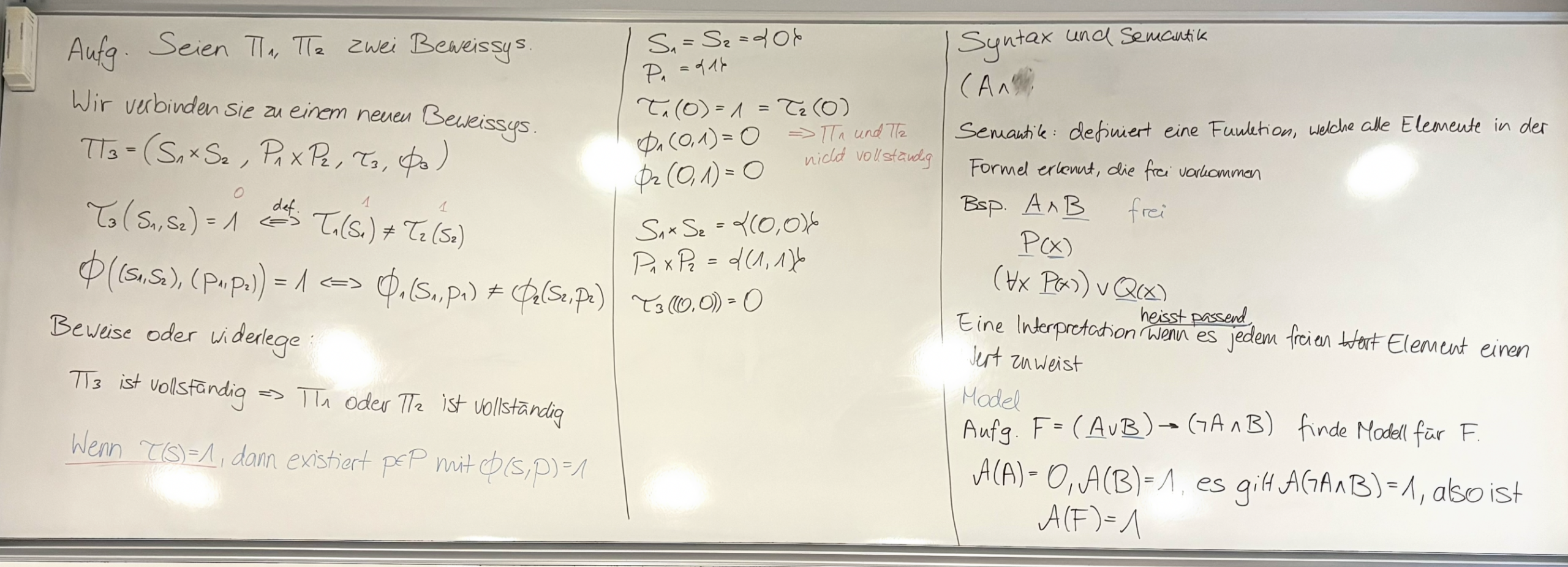
Beweissystem als Tupel:
$$
\Pi = (\mathcal{S}, \mathcal{P}, \tau, \phi)
$$
| Symbol | Name | Beschreibung |
|---|---|---|
| $\mathcal{S}$ | Statements | Menge der Aussagen |
| $\mathcal{P}$ | Proofs | Menge der Beweise |
| $\tau$ | Truth function | Funktion $\tau$: $\mathcal{S} \rightarrow \{0,1\}$; bestimmt, ob eine Aussage wahr (1) oder falsch (0) ist |
| $\phi$ | Verification | Funktion $\phi: \mathcal{S} \times \mathcal{P} \rightarrow \{0,1\}$; prüft, ob p ein gültiger Beweis für s ist. Wenn $\phi(s,p)=1$ und p gültig ist, gibt $\tau(s)=1$ zurück |
Wichtige Eigenschaften:
- Korrekt (sound): Es gibt kein Beweis für eine falsche Aussage $$\forall s \in \mathcal{S} : (\exists p \in \mathcal{P} \text{ mit } \phi(s,p)=1) \implies \tau(s)=1$$
- Vollständig (complete): Für jede korrekte Aussage existiert ein Beweis $$\forall s \in \mathcal{S} : \tau(s)=1 \implies (\exists p \in \mathcal{P} \text{ mit } \phi(s,p)=1)$$
Syntax
- Alphabet $\Lambda$: Menge der erlaubten Symbole
- Formeln $F, G, H$: Syntaktisch korrekte Zeichenketten
Erst wenn Syntax korrekt kann die Semantik überprüft werden.
Semantik
Free
Eine Funktion, die alle freien Elemente findet, also die Semantik weist den Formeln Wahrheitswerte zu. Zum Beispiel:
- In $A \land B$ sind $A$ und $B$ frei.
- In $P(x)$ sind $P$ und $x$ frei.
- In $\forall x P(x)$ ist nur $P$ frei.
Interpretation und Modell
Passende Interpretation: jedem freien Element wird ein Wert zugewiesen
Modell: wahre Interpretaion
Wahrheitswert einer Formel: $\sigma(\mathcal{A}, F)$ ist 0 oder 1, Schreibweise $\mathcal{A}(F)$
$\mathcal{A}(F)=1 \text{ or } 0$, if 1 then A is a model
Relationen
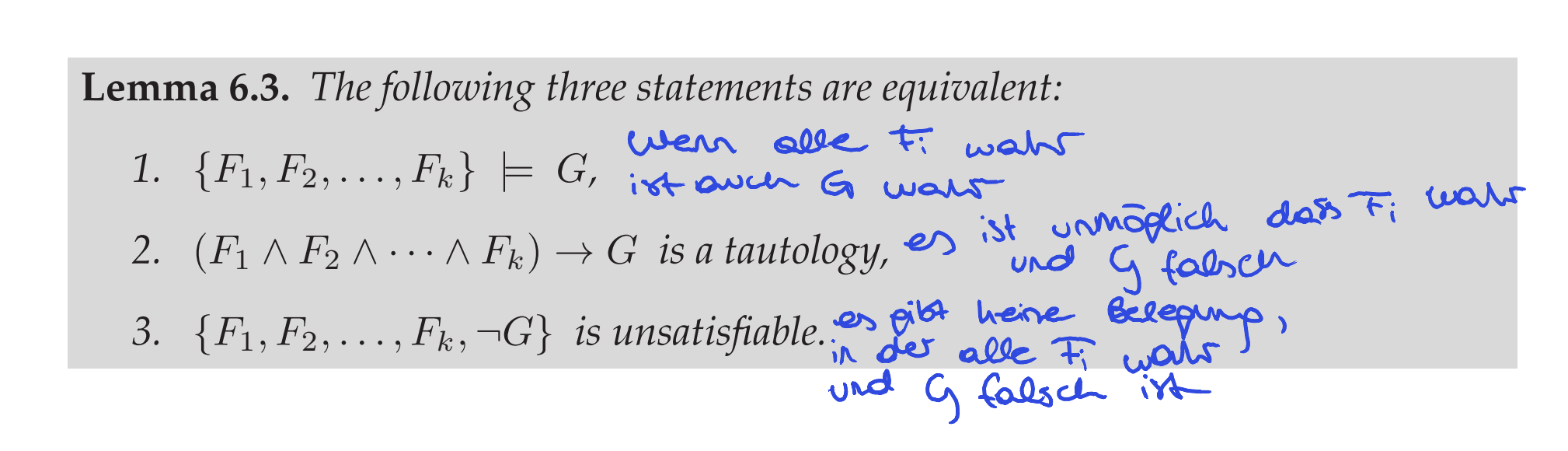
$\models F$ oder $F \models \top$
- Tautologie (gültig), wenn für jede Interpretation wahr
$F \models G$
- jede Interpretation die ein Modell für $F$ oder $M$ ist, ist auch ein Modell für G (macht wahr)
$F \equiv G \quad \Longleftrightarrow \quad F \models G \text{ und } G \models F$
→ [[Tautologie, Logische Konsequenz.png|siehe Skript]]
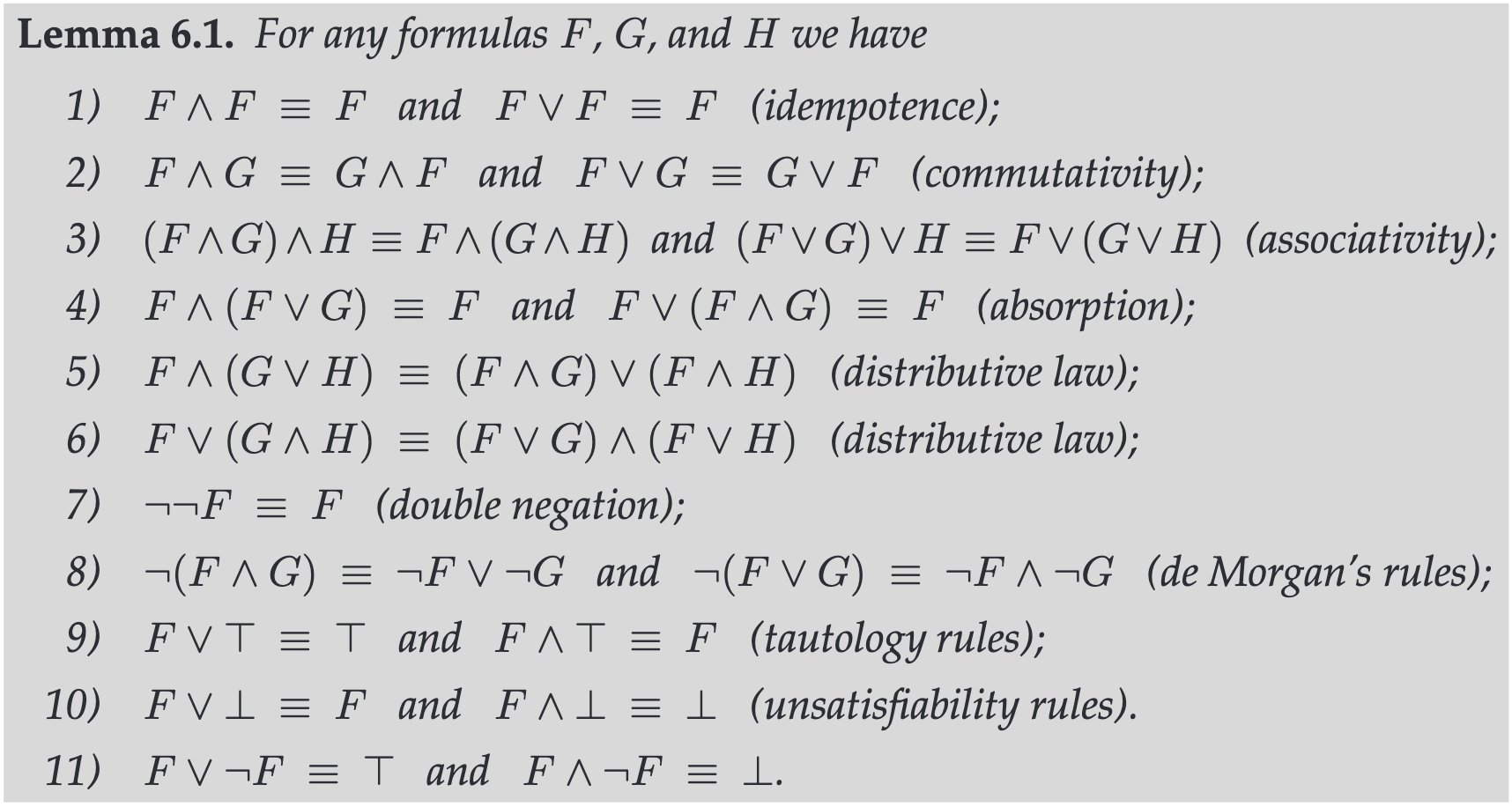
Lemma 6.1